
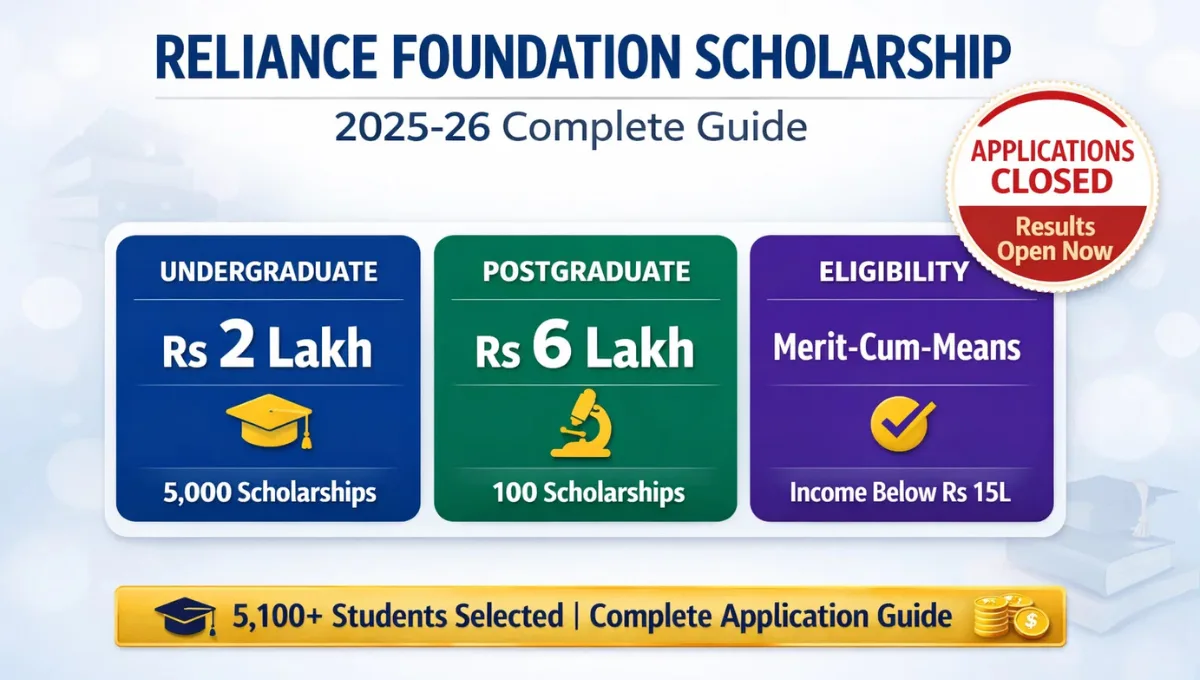
Reliance Foundation Scholarship 2025-26: The Reliance Foundation Scholarship 2025-26 is one of India’s biggest private scholarship programmes. This year, the foundation is selecting 5,100 meritorious students, with 5,000 for undergraduate courses and 100 for postgraduate programmes. If you’re a first-year college student looking for financial support to pursue your degree, or a postgraduate student in engineering or life sciences, this scholarship could be significant for your education.
The 2025-26 cycle is part of Reliance Foundation’s larger 10-year commitment announced in December 2022 to award 50,000 scholarships. The foundation has already supported more than 28,000 scholars who are now working across various sectors in India and globally.
This guide covers everything you need to know about eligibility, application process, selection criteria, and real details about what scholars receive.
Understanding Reliance Foundation Scholarship: Key Facts
Reliance Foundation runs two separate scholarship programmes. It’s important to understand which one applies to you.
Basic Overview
| Aspect | Details |
|---|---|
| Total Students Selected 2025-26 | 5,100 (5,000 UG + 100 PG) |
| Previous Cycle Winners | 28,000+ scholars awarded since inception |
| Application Fee | Completely Free |
| Scholarship Duration | Entire degree programme |
| Official Portal | scholarships.reliancefoundation.org |
What This Scholarship Actually Covers
When you receive a Reliance Foundation Scholarship, you’re not just getting money for tuition. The foundation provides:
- Direct financial grant (deposited into your bank account)
- Mentorship from industry professionals and academicians
- Access to alumni network of 28,000+ scholars
- Internship and industry exposure opportunities
- Skill development workshops and career guidance
- Leadership training and community engagement programmes
- Networking events and conferences
- Professional development funding (for PG scholars)
The financial support is structured differently for undergraduate and postgraduate students, which we’ll detail below.
Reliance Foundation Undergraduate Scholarship 2025-26
Who Can Apply for UG Scholarship
You are eligible for the undergraduate scholarship if you meet ALL of these conditions:
Must-Have Criteria:
- Indian citizen residing in India
- Passed Class 12 with at least 60% marks
- Currently enrolled in 1st year of a full-time, regular undergraduate degree course in 2025-26
- Studying in any stream (Engineering, Science, Commerce, Humanities, Management, Law, or any other recognized programme)
- Household income below Rs 15 lakh per annum
- Willing to appear for the mandatory aptitude test
Income Preference: The foundation gives preference to students whose household income is below Rs 2.5 lakh per annum. However, you can apply if your income is up to Rs 15 lakh.
Who Cannot Apply:
- Students in 2nd year or higher (started courses in 2024-25 or before)
- Students pursuing online, distance, or hybrid learning programmes
- Students pursuing 2-year or 6-year undergraduate courses
- Students who completed diploma after Class 10 and are now in degree courses
- Students from unrecognized institutes
Financial Support: How Much You Get
Selected undergraduate scholars receive:
Total Amount: Up to Rs 2,00,000 (Rs 2 lakh) spread over the entire duration of your degree programme
How It’s Disbursed:
- Funds are transferred directly to your bank account
- Disbursement happens in instalments throughout your course
- Money covers tuition fees and educational expenses
- The exact amount depends on your financial need assessment
If your course is 4 years, roughly Rs 50,000 per year. For 3-year degrees, it could be approximately Rs 66,000 per year.
UG Scholarship Selection Process: Step by Step
The selection process has clear stages. Understanding this helps you prepare better.
Stage 1: Application Submission
You apply online through the official Reliance Foundation scholarship portal (scholarships.reliancefoundation.org). Your application includes:
- Personal and contact information
- Educational background (Class 10, 12, and current college details)
- Academic achievements and awards
- Family income information
- Proof documents (Class 12 certificate, college admission letter, identity proof, income certificate)
- Bank account details for scholarship disbursement
Stage 2: Mandatory Aptitude Test
This is non-negotiable. Every applicant must complete an online aptitude test to be considered.
Test Details:
- Duration: 60 minutes
- Total Questions: 60 multiple choice questions
- Components: Verbal ability, analytical and logical ability, numerical ability
- Passing: There’s no pass/fail, but your score is a significant evaluation factor
- Cheating: Automatic disqualification if you cheat
You can find a sample question paper on the official website to understand the test format.
Stage 3: Merit-Cum-Means Evaluation
The foundation evaluates all applications using a combination of factors:
- Your aptitude test score (weightage: significant)
- Your Class 12 marks or current college marks
- Your household income level (lower income gets preference)
- Academic achievements and awards
Stage 4: Final Selection
The foundation announces up to 5,000 selected scholars. Selection is purely merit-based, but with consideration for financial need. Candidates are ranked on a combined merit-cum-means score.
Important Dates for 2025-26 Cycle
Application Timeline:
- Applications opened: August 21, 2025
- Applications closed: October 4, 2025
- Selection results announced: December 2025
Results are now declared. You can check your status at the official website.
How to Check Results:
Visit: scholarships.reliancefoundation.org
Enter:
- Your 17-digit Application ID, OR
- Your registered Email ID
Status categories you might see:
- Shortlisted: Selected as a scholar
- Waitlisted: On a reserve list; may be selected if scholarships become available
- Not Shortlisted: Not selected in this cycle
If you’re waitlisted, the foundation typically updates status by March 15, 2026.
What Happens After You’re Selected
Once selected, the scholarship disbursement process begins:
First Year:
- You receive 100% of your first-year scholarship amount
- Money transfers to your registered bank account within 30-45 days of selection
- You need to maintain your college enrollment and submit academic records
Subsequent Years:
- Scholarship continues if you maintain minimum academic performance (usually 6.5 CGPA or equivalent)
- You remain in good disciplinary standing with your college
- You participate in foundation-organized scholar development programmes
- You attend mentoring sessions and workshops (at least 80% participation expected)
Conditions You Must Follow:
- Maintain satisfactory academic performance
- No disciplinary issues at college
- Participate in community service activities at least once per year
- Attend mentoring sessions and foundation programmes
- Keep the foundation informed of any changes (address, college, contact details)
- Submit annual progress reports
The foundation doesn’t withdraw scholarships for normal academic struggles or one failed semester. They understand college challenges and provide support to help you succeed.
Reliance Foundation Postgraduate Scholarship 2025-26
Who Can Apply for PG Scholarship
The postgraduate scholarship is more selective and targets specific fields. You’re eligible if:
Basic Eligibility:
- Indian citizen residing in India
- Currently enrolled in 1st year of a full-time, regular postgraduate degree in 2025-26
- Studying in one of the eligible programmes (see below)
- Meet ONE of the academic qualification criteria below
Academic Qualification (Choose One):
| Qualification Type | Requirement |
|---|---|
| GATE Score | Secured 550 to 1,000 in GATE examination (any subject) |
| UG CGPA | 7.5 or above in your bachelor’s degree |
| UG Percentage | Equivalent to 7.5 CGPA when converted (Use formula: CGPA = % marks ÷ 9.5) |
Example for Percentage Conversion: If your bachelor’s percentage was 71.25%, divide by 9.5: 71.25 ÷ 9.5 = 7.5 CGPA (Eligible)
Eligible PG Programmes
The scholarship is available only for these specializations:
- Computer Science and Artificial Intelligence
- Mathematics and Computing
- Electrical and/or Electronics Engineering
- Mechanical Engineering
- Chemical Engineering
- Renewable and New Energy
- Material Science and Engineering
- Life Sciences
Other engineering branches (Civil, Textile, Aerospace, etc.) are not eligible. Check the official website to confirm if your specific programme name matches.
PG Scholarship Financial Support
Selected postgraduate scholars receive:
Total Amount: Up to Rs 6,00,000 (Rs 6 lakh) over the full duration of your PG degree
Disbursement Pattern:
- 80% (approximately Rs 4.8 lakh) disbursed at the beginning of each academic year for tuition and direct academic expenses
- 20% (approximately Rs 1.2 lakh) available upon request for professional development expenses such as:
- Conference attendance and paper presentation
- Professional certifications
- Research publications
- Skill development courses
- Internship and research opportunities
For a 2-year M.Tech, you’d receive roughly Rs 2.4 lakh per year + professional development funding.
PG Scholarship Selection Process
The postgraduate selection is more rigorous than UG. It involves multiple rounds.
Stage 1: Eligibility Check
You submit an eligibility questionnaire first to confirm you meet the academic criteria (GATE score or CGPA).
Stage 2: Full Application
If eligible, you submit a complete application including:
- Personal and academic information
- Educational transcripts and GATE scorecard (if applicable)
- Two reference letters:
- One from an academic advisor or professor (attesting to your academic capabilities)
- One from a mentor, teacher, or professional (attesting to character and leadership)
- Personal Statement (500 words max) explaining your academic interests and vision
- Statement of Purpose (500 words max) about your postgraduate goals and how this scholarship helps
- Supporting documents (identity proof, college enrollment certificate, income certificate optional)
Stage 3: Aptitude Test
Like UG, every PG applicant must appear for the mandatory aptitude test.
Test Details:
- Duration: 60 minutes
- Total Questions: 60 multiple choice questions
- Components: Verbal ability, analytical and logical ability, numerical ability
Stage 4: Initial Evaluation
An expert panel (industry professionals, academicians, and field leaders) reviews all applications:
- Aptitude test score
- Academic excellence (GATE score or CGPA)
- Quality of essays and statement of purpose
- Reference letter endorsements
- Overall potential and vision
Stage 5: Interview
Shortlisted candidates (typically top 200-300 applicants) are called for interviews.
Interview Details:
- Conducted virtually by expert panel
- Duration: Usually 20-30 minutes
- Questions focus on your research interests, career goals, and motivation
- Preparation webinars provided to all shortlisted candidates before interview
Stage 6: Final Selection
The foundation announces 100 selected postgraduate scholars based on:
- Overall merit across all evaluation stages
- Academic excellence
- Research potential and vision
- Leadership qualities
- Interview performance
Important Dates for 2025-26 PG Cycle
- Applications opened: August 21, 2025
- Applications closed: October 4, 2025
- Interviews held: November-December 2025
- Results announced: December 2025
Results Already Declared:
Check your status at: scholarships.reliancefoundation.org
Enter your Application ID or registered email to see: Shortlisted, Waitlisted, or Not Shortlisted.
Post-Selection for PG Scholars
After selection, PG scholars:
- Receive scholarship disbursement (80% upfront each year, 20% on request)
- Get assigned a mentor from industry or research field
- Participate in expert interaction sessions with leading scientists and technologists
- Access internship opportunities with Reliance Group and partner organizations
- Attend leadership and innovation workshops
- Participate in research collaborations
- Join community service programmes
- Access the global alumni network
Maintenance conditions are similar to UG: maintaining academic performance, no disciplinary issues, and participation in foundation programmes.
Documents You Need: Complete Checklist
Gathering documents beforehand saves time during application. Here’s what you need for each category:
Identity and Citizenship Documents
- Aadhar card (digital copy or scanned)
- PAN card (if available)
- Passport (if available)
- Birth certificate
- Voter ID (optional but helpful)
Educational Documents
For UG Applicants:
- Class 10 mark sheet or certificate
- Class 12 mark sheet and certificate (showing minimum 60%)
- College admission letter for current year (2025-26)
- College enrollment certificate or ID card
- First semester/term mark sheet (if available, to show current performance)
- Provisional certificate (if Class 12 results awaited)
For PG Applicants:
- Bachelor’s degree mark sheet and certificate
- Bachelor’s degree transcript showing CGPA clearly
- GATE scorecard and admit card (if applicable)
- Master’s degree admission letter (2025-26)
- College enrollment certificate or provisional admission letter
- Semester mark sheets (if available)
Financial Documents
These are critical. Incomplete or unclear financial documents delay processing.
- Last 3 months’ salary slips of both parents/guardians
- Income certificate from Patwari or Gram Panchayat (latest)
- Previous financial year Income Tax Return (ITR) of parents
- Last 6 months’ bank statements showing monthly income
- Rental agreement (if claiming rental income)
- Agricultural income documentation (if applicable)
- Business registration and GST certificate (if self-employed)
- Property documents (if claiming property income)
For Self-Employed/Business Families: You must provide last 2 years’ complete ITR and balance sheet along with current year ITR or estimate.
Category Certificates (If Applicable)
- Caste certificate for SC/ST/OBC applicants (issued by authorized government authority)
- EWS certificate (for Economically Weaker Section applicants)
- Minority community certificate (if applicable)
- PWD certificate with detailed disability information (for physically challenged applicants)
Other Documents
- Recent passport-size photograph (4×6 cm, white background, no filters or excessive makeup)
- Bank account details (IFSC code, account number, beneficiary name as per bank record)
- College fee receipt or fee structure document
- Course completion certificate or provisional certificate (if Class 12 results pending)
For PG Applicants Additional:
- Two reference letters (on official letterhead with contact details)
- Drafts of Personal Statement and Statement of Purpose
- Research publications or internship certificates (if any)
Document Format Guidelines
- File size: Each document should be less than 5 MB
- Format: PDF, JPG, or PNG acceptable
- Quality: Must be clearly legible (not blurry or cut off)
- Scan settings: High resolution (300 dpi minimum)
- For income certificates: Must be recently issued (not more than 6 months old)
Common Questions About Income and Eligibility
Q: How is household income calculated?
Household income includes all sources:
- Salary of both parents/guardians
- Self-employment or business income
- Agricultural income
- Rental income from property
- Investment returns
- Pension
- Any other income source
For divorced parents, include only the parent’s income who provides financial support. If both contribute, add both incomes.
Q: The income certificate shows Rs 8 lakh but parents say it’s Rs 5 lakh. What do we do?
Submit official income certificate. The foundation cross-verifies all documents. Mismatched information may lead to disqualification. If legitimate variation exists (bonus not included in regular salary, investment returns), add an explanation in the application.
Q: Can I apply if I’ve received other scholarships?
Yes, you can apply even if you have another scholarship. Mention the existing scholarship in your application. If selected for Reliance Foundation Scholarship, the foundation typically provides the difference amount to avoid double benefit or provides the full amount depending on their policy.
Q: What if my family income exceeds Rs 15 lakh (for UG)?
Unfortunately, you’re ineligible for the UG scholarship. The income limit is strict. You can appeal in writing to the helpline with supporting documents if there are extraordinary circumstances, but the foundation rarely makes exceptions.
Q: Do girls and specially-abled students have any advantage?
The foundation encourages applications from girls and specially-abled (PwD) students and gives them preference during selection, all else being equal. However, this doesn’t mean a lower cut-off for merit. It means if two candidates have similar merit-cum-means scores, preference is given to girls or PwD candidates.
Application Process: Detailed Steps
Step 1: Visit Official Website
Go to scholarships.reliancefoundation.org
For UG: Click on “Undergraduate Scholarship” For PG: Click on “Postgraduate Scholarship”
Step 2: Create Your Account
Click “Apply Now” button on the scholarship page.
You’ll be directed to the application portal (scholarshipportal.reliancefoundation.org)
Register with:
- Email address (use one you check regularly)
- Mobile number (WhatsApp enabled preferred, for updates)
- Create a strong password
- Verify your email and mobile through OTP
Save Your Registration Details: Note your Application ID generated after registration. You’ll need it to check status and login later.
Step 3: Fill Personal Information Section
- Full name (exactly as on Class 12 certificate)
- Date of birth
- Gender
- Category (General, OBC, SC, ST, EWS, PwD)
- Mobile number and email
- Permanent address
- Current address
- Contact details
Ensure spelling matches your documents. Mismatches can delay processing.
Step 4: Enter Educational Details
For UG Applicants:
- Name and details of current college
- Course name and stream
- Class 10 marks and percentage
- Class 12 marks and percentage (minimum 60% required)
- Board name (CBSE, State Board, ICSE, etc.)
- Any entrance exam scores (if applicable)
- Achievements and awards during school
For PG Applicants:
- Bachelor’s degree details (institution, graduation year, percentage/CGPA)
- Current PG programme (name, institution, specialization)
- GATE score and exam year (if applicable)
- Research papers or publications (if any)
- Internship or work experience (brief details)
- Awards and recognitions
Step 5: Financial Information
This section is crucial and thoroughly verified.
- Father’s full name and occupation
- Father’s monthly/annual income
- Mother’s full name and occupation
- Mother’s monthly/annual income
- Other family members’ income (if applicable)
- Total household income (it calculates automatically)
- Number of dependents
- Monthly household expenses (rough estimate)
- Any existing scholarships or financial aid
Important: The foundation cross-checks this against official documents. Submit truthfully. False information leads to disqualification and potential legal action.
Step 6: Upload Required Documents
Upload each document as a separate file:
- Class 12 certificate
- College admission letter/enrollment certificate
- Aadhar or identity proof
- Income certificate
- Latest salary slip (if salaried parents) or ITR (if self-employed)
- Bank account details document
- Recent passport-size photograph
- Any other requested documents
Upload Tips:
- Ensure documents are clear and fully visible
- Use a mobile scanner app for best results (Google Drive scan, CamScanner, or Adobe Scan)
- Check file size before uploading
- Upload complete documents, not partial pages
Step 7: Appear for Aptitude Test (UG) or Complete Questionnaire (PG)
UG Students: Complete the 60-minute aptitude test
- Test appears in your portal after form submission
- Schedule it within 7 days of application
- You can retake it if needed (highest score counts)
- Be in a quiet space with stable internet
- Have a valid government ID (Aadhar, Passport) ready as per test instructions
PG Students: Submit the eligibility questionnaire first
- Confirm your GATE score or CGPA
- Fill additional academic details
- Only after approval of eligibility can you proceed with full application
Step 8: Review and Submit
Before final submission:
- Check all information for spelling errors
- Verify all amounts (income, marks) match documents
- Confirm all documents are uploaded
- Review personal statement (PG) or essay (if required)
- Check your bank account details are correctly entered
Click “Submit Application.”
You’ll receive a confirmation message with your Application ID. This ID is crucial for checking status later.
Step 9: Receive Confirmation Email
Within 24 hours, you’ll receive:
- Confirmation of application submission
- Your unique Application ID
- Link to download application copy
- Further instructions if any
Bookmark this email. Don’t delete it.
Selection Criteria Explained Clearly
What “Merit-Cum-Means” Actually Means
This term confuses many students. Here’s the reality:
Merit = Your academic performance
- Class 12 marks
- College marks
- Aptitude test score
- Academic achievements
Means = Your economic situation
- Family income
- Financial need
- Ability to afford education
Merit-Cum-Means = Combination of both
The foundation doesn’t just pick toppers. It looks for deserving students who need financial help to continue education. A student with 85% marks and Rs 2 lakh income gets preference over a student with 95% marks and Rs 12 lakh income.
How Ranking Works
The foundation uses a formula that combines:
- Your aptitude test score (weighted significantly)
- Your academic performance (Class 12 or college marks)
- Your income level (lower income gets advantage)
- Your overall profile (achievements, awards, leadership)
Students are then ranked from highest to lowest score. The top 5,000 (for UG) or 100 (for PG) are selected.
Special Preferences
Within the merit-cum-means ranking, the foundation gives preference to:
- Girls (female students)
- Students with disabilities (PwD category)
- Economically weaker families
This doesn’t lower the merit bar, but if two students have similar scores, the one from the preferred category gets selected.
What Documents Show Income Verification
The foundation doesn’t accept claims. They require official documents.
For Salaried Parents
Required:
- Last 3 salary slips (consecutive months)
- Form 16 from employer for last financial year
- Bank statements showing salary credits (6 months minimum)
This proves regular employment and actual income received.
For Self-Employed/Business Owners
Required:
- Last 2 years’ complete Income Tax Returns with Schedule sheets
- Latest business registration/GSTIN certificate
- Bank statements showing business transactions (12 months)
- Balance sheet and profit-loss statement (if annual auditor is available)
The foundation verifies ITR with Income Tax Department. False claims are caught.
For Agricultural Income
Required:
- Land revenue records/Jamabandi
- Agricultural income certificate from Patwari/Gram Panchayat
- Bank statements showing income from agricultural sales
For Rental Income
Required:
- Rental agreement (registered/notarized)
- Property documents (registry or sale deed)
- Bank statements showing rent receipts
- Municipal property tax receipts
Income Certificate from Government
Most important document:
- Issued by Patwari, Gram Panchayat Officer, or Municipal Authority
- Must be recent (not older than 6 months from application date)
- Must state exact annual income
- Must have official seal and signature
- Contains document reference number and date of issue
The foundation verifies income certificates by cross-checking with government records. Fake certificates are detected and applicants are blacklisted.
Real Details: What Happens When Selected
Scholarship Disbursement
Once selected (typically 4-6 weeks after results):
- You receive an email with disbursement details
- Money is transferred to your bank account (the account you mentioned in application)
- You receive SMS confirmation when funds are credited
- Bank transfer takes 1-2 business days typically
Check your bank statement. Don’t just wait for email confirmation.
Documentation After Selection
After selection, you need to submit:
- Copy of your bank account passbook (first page showing account details)
- Proof of current college enrollment for the academic year
- Address proof (utility bill or any government document with address)
- Undertaking that all information provided is true
Missing these documents delays disbursement.
Academic Conditions
To continue receiving scholarship in subsequent years:
- Maintain minimum CGPA of 6.5 or percentage equivalent (roughly 60%)
- No disciplinary action or suspension from college
- No cheating or academic misconduct
- Attend at least 80% of mandatory scholar development programmes
- Complete one community service activity per year
If you fail a subject: Inform the foundation. They may ask for improvement plan but don’t immediately cancel scholarship. They understand college challenges.
If you drop out: Scholarship ends immediately. No further disbursement.
If you take a break year: Inform the foundation. Some flexibility exists, but scholarship is for continuous study.
Scholar Community Benefits
Beyond money, you gain:
Mentorship: Assigned a mentor from industry or academia. Monthly or quarterly contact with career guidance.
Alumni Network: 28,000+ scholars across all sectors. Access to networking events, job referrals, collaborations.
Workshops: Monthly skill development sessions on topics like interview preparation, entrepreneurship, digital marketing, leadership, social impact.
Industry Exposure: Site visits to Reliance Group facilities, exposure to new technologies, understanding real-world applications.
Internships: Direct placement opportunities with Reliance Group companies and partner organizations.
Networking Events: Annual scholar conference where you meet peers, industry leaders, policymakers. Huge networking opportunity.
Research Opportunities (PG): Collaboration with research institutions, chance to publish papers, attend academic conferences.
Volunteering: Community service opportunities through Reliance Foundation’s social programmes. Address real social issues.
Career Support: Direct help with resume, interview preparation, job search, internship placement.
These benefits often matter more than the scholarship amount for your long-term career.
Red Flags: Mistakes That Get Applications Rejected
Understanding what goes wrong helps you avoid it.
False or Misleading Information
The most common reason for rejection:
- Income misrepresented (claiming lower than actual)
- Income certificate that doesn’t match ITR or salary slips
- Fake documents or forged signatures
- Inconsistent information across forms and documents
Consequence: Immediate rejection. Possible blacklisting. Your college and state education board may be notified.
Missing Mandatory Aptitude Test
Many applicants skip the aptitude test thinking it’s optional. It’s not.
Consequence: Automatic disqualification. Application cannot be considered without test score.
Income Above Threshold
If your household income exceeds Rs 15 lakh (for UG), you’re not eligible, period. The foundation doesn’t make exceptions.
Consequence: Rejection despite strong academics.
Wrong Course Category
Applying for UG scholarship as a 2nd year student, or PG scholarship in an ineligible course.
Consequence: Automatic rejection based on eligibility criteria.
Incomplete or Unclear Documents
Submitting blurry scans, cut-off pages, or illegible documents.
Consequence: Processing delays. Verification teams can’t validate documents. Application may get rejected or put on hold indefinitely.
Two Years of Study
If your current admission is from 2024-25 or earlier, you’re not a first-year student in 2025-26.
Consequence: Ineligible. You cannot apply.
Poor Aptitude Test Performance (UG Only)
While there’s no pass/fail, extremely low scores reduce your merit ranking significantly.
Consequence: Not selected, even if income is low and academics are decent.
Not Following Requested Information
Application asks for specific details and you provide something else, or leave fields blank.
Consequence: Incomplete application. Moved to lower priority in evaluation.
Official Contact and Support Resources
Helpline Numbers and Email
Undergraduate Scholarship:
- WhatsApp: Text “hi” to 7977 100 100
- Phone: (011) 4117 1414
- Email: RF.UGScholarships@reliancefoundation.org
- Best time to call: 10 AM to 5 PM, Monday to Friday
Postgraduate Scholarship:
- WhatsApp: Text “hi” to 7977 100 100
- Phone: (011) 4117 1414
- Email: RF.PGScholarships@reliancefoundation.org
Response time: Usually within 24-48 hours for email, 30 minutes to 2 hours for WhatsApp during business hours.
Official Websites and Portals
Main Scholarship Website: scholarships.reliancefoundation.org
UG Scholarship Page: scholarships.reliancefoundation.org
PG Scholarship Page: scholarships.reliancefoundation.org
Application Portal: scholarshipportal.reliancefoundation.org
Check UG Results: scholarships.reliancefoundation.org
Check PG Results: scholarships.reliancefoundation.org
FAQs and Documents:
- UG FAQ PDF: Available on UG scholarship page
- PG FAQ PDF: Available on PG scholarship page
- Sample Aptitude Test: Available on scholarship page
Fraudulent Activities Warning
Important: Reliance Foundation warns that fraudsters impersonate representatives and demand deposits or money for “processing.”
Know This:
Reliance Foundation NEVER asks for:
- Deposits or upfront money
- Processing fees
- Registration charges
- Any payment whatsoever
The application is 100% FREE.
If You Encounter Fraud:
- Do NOT give money to anyone
- Save all communication details
- Report immediately to WhatsApp number: 7977 100 100
- Email: rf.scholarships@reliancefoundation.org
- File complaint with local police
- Inform your college authorities
Sample Aptitude Test and Preparation
What the Test Covers
Based on official information, the 60-minute test (60 questions) covers:
Verbal Ability (20 questions, roughly):
- Reading comprehension (short passages)
- Vocabulary and word meanings
- Sentence completion
- Grammar and usage
- Synonyms and antonyms
Analytical and Logical Ability (20 questions, roughly):
- Logical reasoning
- Pattern recognition
- Analogies
- Data interpretation from tables/charts
- Sets and relationships
- Syllogisms
Numerical Ability (20 questions, roughly):
- Basic arithmetic (percentages, profit-loss, ratios)
- Algebra and equations
- Geometry and mensuration
- Time and work problems
- Number series and sequences
- Probability basics
Practice Resources
Official Sample Paper: Download from: https://www.scholarships.reliancefoundation.org/ (PDF link on the page)
This sample paper shows exact question format and difficulty level.
Free Online Preparation:
- Khan Academy (Math and reading comprehension)
- Vedantu YouTube channel (logic and reasoning)
- Byju’s (aptitude test preparation)
- IndiaBIX (aptitude questions with detailed solutions)
Standard Books:
- “Quantitative Aptitude for Competitive Examinations” by RS Aggarwal
- “A Modern Approach to Verbal and Non-Verbal Reasoning” by RS Aggarwal
- “Verbal Ability and Reading Comprehension” by Ajay Singh
Test-Taking Tips:
- Attempt easy questions first, skip difficult ones
- Don’t spend more than 1 minute per question
- Review answers if time permits
- Read questions carefully before answering
- No negative marking mentioned, so attempt all questions
Timeline and Planning Guide
For 2026-27 Cycle (If You Missed 2025-26)
The scholarship cycle repeats every year. Here’s the typical timeline:
| Milestone | Typical Timeline |
|---|---|
| Announcement & Portal Opening | Late August 2026 |
| Application Opening | August 21, 2026 |
| Application Deadline | October 4-7, 2026 |
| Aptitude Test Window | September-October 2026 |
| Interview (PG only) | November-December 2026 |
| Results Announcement | Mid-December 2026 |
| Waitlist Updates | March 15, 2027 |
| Scholarship Disbursement Begins | January-February 2027 |
Planning Actions Now:
- Improve your Class 12 marks or college GPA
- Prepare for aptitude test (especially if you scored low before)
- Gather and organize all documents
- Ensure your income documentation is current and authentic
- Get reference letters ready (for PG students)
Common Questions Students Actually Ask
Q: I got selected as waitlisted. What are my chances of final selection?
A: Waitlist means you’re very close to selection. When selected students decline or don’t respond, waitlisted candidates are offered scholarships. Historically, 15-20% of waitlisted candidates eventually get selected. Stay in touch with the foundation and confirm your interest immediately.
Q: Can I apply if I’m studying through correspondence or open university?
A: No. The scholarship explicitly requires full-time, regular mode of study. Correspondence, distance, online, or hybrid learning doesn’t qualify.
Q: What if I don’t have a Class 12 certificate yet (awaiting results)?
A: You can still apply using a provisional certificate or exam admit card. But you must have passed with minimum 60% by the time scholarship is actually disbursed. If you fail to meet 60%, disbursement is withheld.
Q: I’m a diploma holder. Can I apply for UG scholarship now?
A: No. The scholarship explicitly excludes students who completed diploma after Class 10. Only students going directly from Class 12 to bachelor’s degree are eligible.
Q: Can I appeal if I’m rejected?
A: The foundation doesn’t have a formal appeals process. However, if you believe there’s an error in your application evaluation, you can write to the helpline with specific reasons and supporting documents. Response is not guaranteed, and appeals rarely succeed.
Q: What if my college is unrecognized or newly established?
A: Your college must be recognized by the government (state education board or central government). Contact the helpline with your college details. If unrecognized, you’re not eligible.
Q: I changed my college after admission. Can I still apply?
A: Yes. You need to be a first-year student in 2025-26, studying in a recognized college. If you transferred to another college but are still in 1st year, you can apply. Update your application with new college details.
Q: My parents are divorced. Whose income do I report?
A: Report the income of the parent who provides your financial support. If both contribute significantly, report combined income. Mention this situation in the application’s “Additional Information” section.
Q: Can I apply if my family recently suffered financial loss (medical emergency, business failure)?
A: Yes. If your actual current financial situation is worse than your ITR shows, mention this in “Additional Information.” The foundation may consider temporary setbacks. Provide supporting documents (medical bills, business closure notices, etc.).
Q: What happens if I’m caught cheating in the aptitude test?
A: You’re immediately disqualified and marked as ineligible. This information is shared with your college and state education board. You cannot reapply in future cycles.
Q: Does the scholarship help with hostel fees or is it only for tuition?
A: The scholarship amount goes directly to you. You can use it for tuition, fees, books, hostel, meals, or any educational expense. It’s not restricted to specific heads.
Realistic Acceptance Rates
Understanding competition levels helps set realistic expectations.
Undergraduate Scholarship:
- Approximately 100,000 to 150,000 applicants annually
- 5,000 selected
- Acceptance Rate: 3-5%
Postgraduate Scholarship:
- Approximately 800 to 1,200 applicants annually
- 100 selected
- Acceptance Rate: 8-12%
The PG scholarship is less competitive because:
- Fewer eligible students (only specific programmes)
- Smaller candidate pool (postgraduate students are fewer than undergraduates)
- Fewer seats (100 vs 5,000)
The UG scholarship is highly competitive because:
- Open to all undergraduate students across all streams
- Much larger candidate pool (nearly 2 million students take admission yearly)
- Merit-cum-means applicants are huge in number
What Score Do You Realistically Need?
For UG Scholarship:
To be competitive, you typically need:
- Class 12 marks: 85% and above
- Aptitude test: 50+ out of 60 (roughly 80+ percentile)
- Household income: Below Rs 5 lakh (strong preference)
Students with lower income (Rs 2.5 lakh or below) can get selected with slightly lower academics.
For PG Scholarship:
To have a real chance:
- GATE Score: 700+ (out of 1000) for engineering streams
- Bachelor’s CGPA: 8.5 or above
- Aptitude test: 50+ out of 60
- Essay quality: Strong personal statement showing clear research vision
- References: Excellent reference letters from respected academicians
PG selection is heavily merit-driven. Income is not a factor. Only academic excellence and research potential matter.
Selection Reality Check
Here’s what actually happens:
Typically Selected:
- Very strong academics (Class 12: 90%+, or current college CGPA: 8.0+)
- Good aptitude test performance (50+ out of 60)
- Low to middle-income families
- Some unique achievement or leadership quality
Rarely Selected:
- Average academics (75-80%) despite low income
- Students who just pass the aptitude test (30-35 out of 60)
- Very high income (above Rs 10 lakh)
Never Selected:
- Those who skip the aptitude test
- Students caught cheating
- Candidates with false documents
- Students who submit incomplete applications
Comparison: Reliance vs Other Major Scholarships
If Reliance Foundation doesn’t work out, here are comparable large-scale scholarships:
| Scholarship | For Whom | Amount | Selection | Application Timeline |
|---|---|---|---|---|
| Reliance Foundation UG | 1st year UG, all streams | Rs 2 lakh | Merit-cum-means | Aug-Oct |
| Inspire Scholarship | Science stream students | Rs 80,000 | Merit-based | Jan-April |
| AICTE Scholarship | Engineering students | Varies | Merit + need-based | Ongoing |
| National Scholarship Portal | Multiple categories | Varies | Government schemes | Year-round |
| TCS Scholarship | Engineering/Technology | Rs 5 lakh | Merit-based | Sept-Nov |
| IIT/NIT Institute Scholarships | Students in respective institutes | Full tuition + stipend | Merit-based | Jan-April |
| State Scholarships (SC/ST/OBC) | SC/ST/OBC/EWS students | Varies by state | Income + category | Aug-Dec |
Key Difference: Reliance Foundation accepts all streams (not just engineering or science) and uses pure merit-cum-means approach.
Where to Apply:
- Inspire Scholarship: https://www.inspirescholarship.gov.in/
- National Scholarship Portal: https://scholarships.gov.in/
- State Scholarship Portals: Check your state education ministry website
Don’t limit yourself to one scholarship. Apply to multiple schemes simultaneously.
Important: What to Do If Not Selected
If you’re not selected, it’s not the end. Many successful engineers and professionals weren’t Reliance scholars.
Immediate Actions
Within 1 Week:
- Check if you’re waitlisted (there’s still a chance)
- Read feedback if available (sometimes the portal shows reasons for rejection)
- Contact the helpline to understand if there’s any error in evaluation
Within 1 Month:
- Apply for other major scholarships (TCS, Inspire, state scholarships)
- Check if your college offers internal merit scholarships
- Explore educational loans from banks (with parent co-signer)
- Investigate government student loans at subsidized rates
Alternative Funding Options
Parent Bank Loans:
- HDFC, ICICI, Axis offer education loans at 7-9% interest
- Processing fast (10-15 days)
- EMI can start after course completion
National Loan Schemes:
- Pradhan Mantri Vidyalakshmi Portal: https://www.vidyalakshmi.nls.gov.in/
- Multiple lenders offering loans at reasonable rates
Employer Sponsorship:
- Some companies sponsor education for employees’ children
- Check with your parent’s employer
Government Schemes (State-Specific):
- Check your state education ministry website
- Many states offer scholarships for merit and financial need
Final Points: Making Your Application Stand Out
While merit-cum-means is the primary criteria, your overall presentation matters.
Write Better Essays (PG Requirement)
Personal Statement: Show who you are beyond grades.
- Don’t just list achievements
- Share a challenge you overcame
- Show self-awareness and reflection
- Keep it authentic (no flowery language)
- Limit to 500 words
Statement of Purpose: Show clarity of goals.
- What research area interests you specifically?
- Why does it matter?
- How will this scholarship help?
- What impact do you want to create?
- Show realistic, achievable goals
- Limit to 500 words
Example (Bad): “I want to do postgraduation in computer science to become a software engineer and help India grow in technology. The scholarship will help me focus on studies.”
Example (Better): “During my undergraduate project on machine learning, I realized how inefficiently Indian agricultural systems use crop data. I want to specialize in AI to develop predictive models for monsoon patterns and irrigation optimization, directly impacting farmers’ income. Reliance Foundation’s support would let me focus entirely on research instead of part-time work, enabling me to publish quality papers and collaborate with agricultural researchers.”
Get Strong Reference Letters (PG)
References matter significantly in PG selection.
What to Request:
- From one professor who taught you (academic reference)
- From a mentor, workplace senior, or community leader (character reference)
What They Should Cover:
- Your academic ability and intellectual curiosity
- Specific examples of your work or projects
- Your potential and aspirations
- Your character and integrity
- Why they specifically recommend you
What Makes a Letter Strong:
- Specific details (not generic praise)
- Personal anecdotes showing your capability
- Clear connection to why you’re pursuing this field
- Recommendation is on official letterhead with signature
- Includes contact information of the recommender
What Makes a Letter Weak:
- Generic praise (“Very good student”)
- No specific examples
- Too short (less than 200 words)
- No official details
- Too many grammatical errors
Authenticity Matters
The foundation reviewers read hundreds of applications. They can tell authentic from generic.
Your documents, essays, and test performance paint a picture. If something seems fabricated or inflated, it stands out negatively.
Be Honest:
- Your true academic level
- Your real financial situation
- Your genuine goals and interests
- Your actual achievements (don’t exaggerate)
Honest applications with genuine need and decent merit outperform dishonest applications with inflated claims every time.
Bottom Line: Is Reliance Foundation Scholarship Worth the Effort?
Absolutely. Here’s the reality:
Rs 2 lakh (UG) to Rs 6 lakh (PG) is significant money. For many families, this amount covers entire education costs or substantially reduces financial burden.
Beyond money, the network is invaluable. Connecting with 28,000 scholars across industries, getting mentorship from leaders, and accessing internships creates long-term career opportunities worth far more than the scholarship amount.
The selection is rigorous, yes. But transparent and fair. Merit-cum-means approach ensures deserving students get support, not just toppers.
The effort is 3-4 hours of application time and 60 minutes of aptitude test. Return on effort is enormous if selected.
Even if not selected, the process teaches you application skills useful for future opportunities.
Apply if you’re eligible. Prepare seriously. Submit on time. And keep realistic expectations.
That’s it. Good luck.
Last Updated: January 28, 2026